36Kr Exclusive | USTC Team's Space Intelligent Computing Platform Raises Over 100 Million Yuan, Backed by Bohua, Matrix Partners, Hillhouse and Others
Author | Qiao Yujie Editor | Yuan Silai **This article is approximately 3,500 words, suggested reading time: 7 minutes
36Kr Hard Tech learned that Zhongke Miwei, focused on space intelligent computing and satellite intelligence, recently completed its A1 and A2 funding rounds, with total financing exceeding 100 million yuan. Investors include Bohua Capital, Matrix Partners China, Hillhouse Ventures, Yushi Space, China-Singapore Group, Baidu Ventures, Xinrui Capital, Huakong Fund, USTC Silicon Valley Ventures, and others. IO Capital served as the exclusive financial advisor. This round's investor lineup spans aerospace industry capital, top-tier venture firms, and industry players, providing industrial resources to support the company's further expansion in space intelligent computing and core satellite intelligence systems. For commercial spaceflight, as satellite numbers continue to grow, how to process massive volumes of in-orbit data, reduce data downlink pressure, and make satellites more intelligent with autonomous operational capabilities is becoming a new infrastructure requirement. Zhongke Miwei was incubated by the University of Science and Technology of China (USTC) and the Shanghai Processor Center. The team has been tackling challenges in intelligent computing architecture and space engineering for nearly a decade. Company founder Wang Ziyan previously served as vice president of a listed AI chip company, and the co-founding team members all come from the USTC School of Software.**
Zhongke Miwei positions itself as a "builder of space intelligent computing and satellite intelligence solutions," constructing a new-generation intelligent constellation computing architecture of "Star Intelligence — Island Computing, Star-Island Collaborative Intelligence." Currently, the company's core products include highly reliable space computer hardware, an onboard service-oriented operating system, and a computing architecture for constellation-based distributed collaboration.
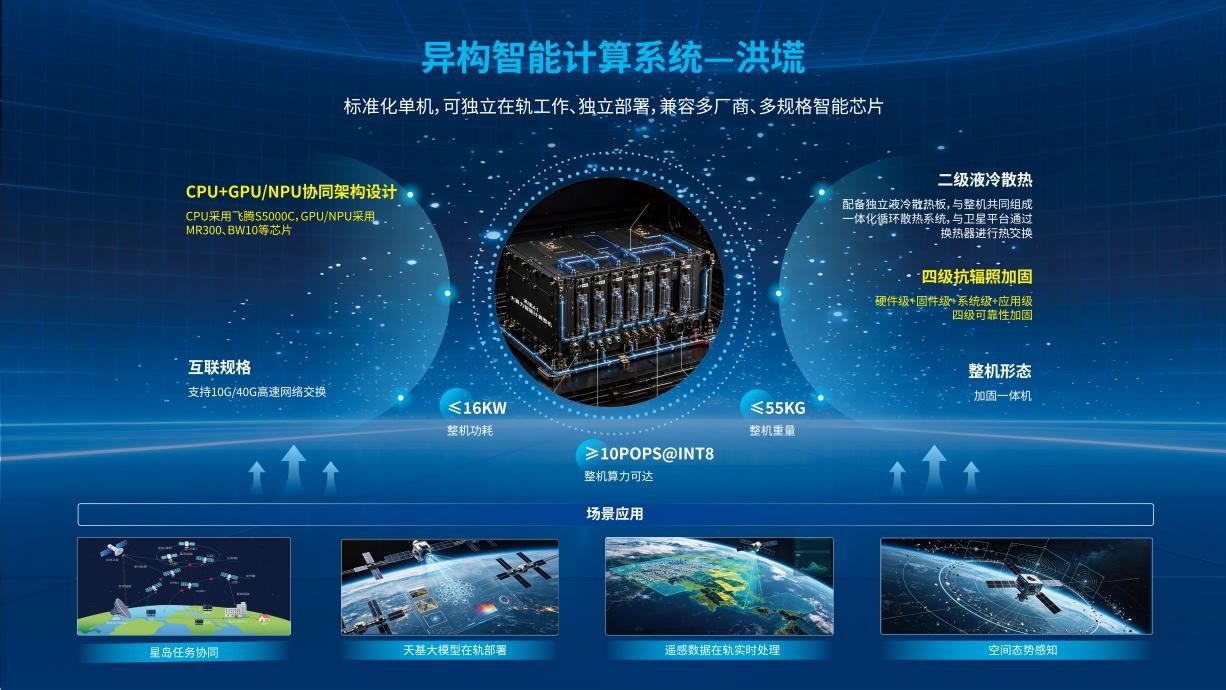
At the hardware level, Zhongke Miwei has launched the Honghuang, a fully domestically produced heterogeneous intelligent computing system, covering form factors from modules to complete machines to full systems. The product features four-level reliability across hardware, firmware, software, and systems, and supports harsh radiation environments across all orbital planes. It primarily addresses the challenge of high-density intelligent computing under satellites' limited power, limited volume, and strong radiation conditions, while supporting collaborative operation of different chip types including CPU, GPU, NPU, and FPGA.
Its computing power can be modularly combined on demand, with integrated computing and thermal control delivery, covering space computing needs ranging from tens of TOPS to tens of POPS.
(Image source: Company)
At the software level, Zhongke Miwei has launched the Xuanhuang OS, a service-oriented operating system designed for heterogeneous intelligent computing. It provides a unified abstraction of different types of underlying computing hardware, allowing developers to invoke underlying computing power through a unified software environment rather than developing and adapting separately for different chips. This lowers the barrier to developing and deploying intelligent applications and improves algorithm iteration efficiency.
(Image source: Company)
Beyond enabling individual satellites with intelligent computing capabilities, the company has also independently developed a "Star-Island" collaborative computing architecture. Here, "Star" refers to sensing satellites equipped with intelligent computing capabilities, while "Island" refers to computing node satellites deployed in space that provide in-orbit computing power replenishment and access for sensing satellites. Under this architecture, satellites can further collaborate with other satellites and space computing node satellites.
An individual satellite can complete tasks such as target recognition, mission planning, and data interpretation in orbit, while for tasks with higher computing demands, it can further leverage the computing power of other nodes.
(Image source: Company)
In terms of commercialization, Zhongke Miwei has already formed a multi-tiered service model ranging from standard products to system solutions. On one hand, the company offers standardized hardware and software products such as Honghuang modules and complete machines; on the other, it provides customized intelligent computing systems based on different satellite missions, further extending to support services that help satellite manufacturing and constellation operating enterprises achieve flexible, agile, and lower-cost R&D and industrial manufacturing capabilities.
Currently, Zhongke Miwei's products have been applied in commercial spaceflight, national major projects, manned spaceflight, and deep space exploration. The company disclosed that the team's early accumulation of nearly a decade has supported four satellites carrying computing products operating stably in orbit, with the longest in-orbit operation approaching five years. The company currently has over 25 products in development and is the only company in China capable of delivering fully domestically produced space computing products across low, medium, and high orbital planes.
The following is an excerpt of 36Kr Hard Tech's conversation with founder Wang Ziyan:
36Kr Hard Tech: The team began R&D on "computing in space" in 2018. What's the difference between that early R&D and now?
Wang Ziyan: The entire effort of bringing computing to space has been continuously iterating alongside the evolution of China's semiconductor and foundational industrial supply chain. In the early days, we used chips with relatively limited computing power and consumption, solving small model inference problems. Moreover, the tasks that helped us build our expertise had extremely demanding aerospace engineering requirements.
The challenge of going from 0 to 1 was significant, but it provided comprehensive training for our current capabilities across all dimensions — that has been our fortune.
Now, as computing chip capabilities continue to improve and manufacturing processes keep breaking through, the challenges for current R&D are multifaceted. We consistently focus on two starting points: engineering feasibility and commercial viability. We must consider the constraints of the limited satellite platform working environment, address radiation resistance and vacuum heat dissipation for high-power devices, and also consider optimization for onboard application compatibility, as well as overall computing architecture optimization under highly time-varying, non-stationary communication environments.
This demands a very comprehensive technology stack from the team and raises the bar for engineering capabilities.
36Kr Hard Tech: From early small-computing-power chips to today's large-computing-power payloads, what technical difficulties have increased? What challenges do hardware and software respectively face?
Wang Ziyan: In the early days, the chips we sent to space had low computing power and consumption, and satellite missions were very focused. We could optimize a dedicated system for a specific application. Now, onboard application needs are more generalized, and computing demands are greater.
We face many different AI chips, and architectural differentiation and software stack fragmentation are both challenges for application generalization. At the same time, space computing faces constraints on power supply, weight, power density, and heat dissipation, all within a limited range. The system software architecture must adapt to these extreme conditions — the operating system, task scheduling, and distributed collaboration all need to be redesigned.
Looking further at the specific hardware level, large computing power...