Securing Over 100-Unit Order from CNPC: This Company Provides "Inspection-Operation Integrated" Robots for Highly Hazardous Chemical Scenarios | 36Kr Exclusive
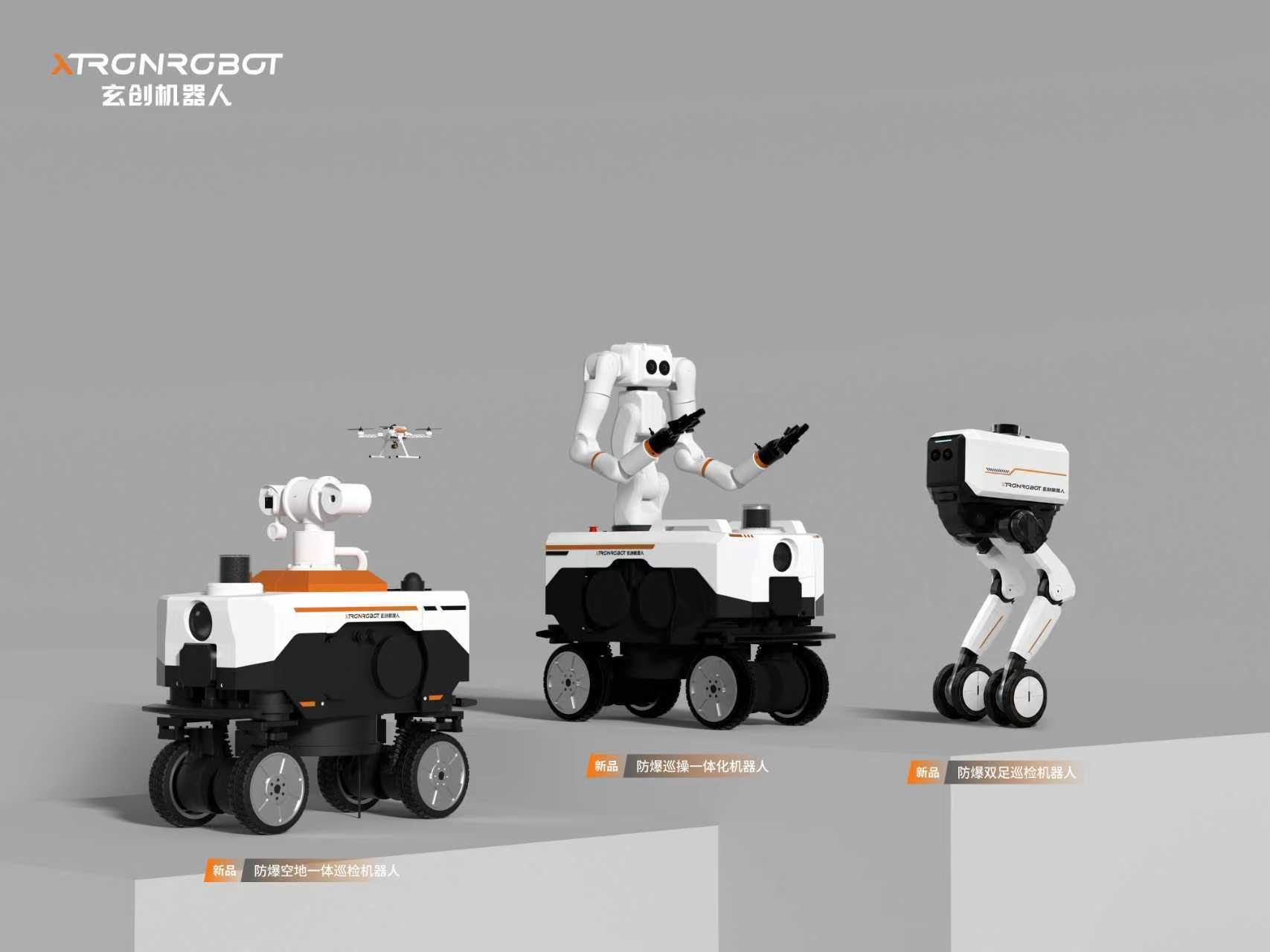
Image source / Enterprise
This article is about 2,600 words, suggested reading time 6 minutes
Author | Ou Xue
Editor | Yuan Silai
36Kr learned that Xuanchuang Robot, an embodied robot company for highly hazardous industrial scenarios, has completed tens of millions of yuan in an A1 funding round. Investors include Qianhai Fangzhou, Guangyang Co., and West Lake Sci-Tech Investment.
The funds will primarily be used for data pipeline construction, training and deployment of VLA and JEPA world models, as well as the stocking and production of standardized products.
Founded in December 2022, Xuanchuang Robot has long been deeply engaged in highly hazardous industrial scenarios such as oil, gas, and chemicals, focusing on the development and application of special embodied intelligent robots.
The company's core team mainly comes from Harbin Institute of Technology (HIT), and its technological achievements stem from the R&D transformation of the HIT Robot Research Institute and the Fujian (Quanzhou) Advanced Manufacturing Technology Research Institute. Founder and CEO Fu Zhe has an educational background at HIT, University of Birmingham, University of Sheffield, and Imperial College London, and previously worked at large multinational companies like Schaeffler, responsible for the energy sector business.
Overall, traditional manual methods have low efficiency and high risks in extreme environments, and the industry faces severe workforce aging and labor shortages. Moreover, driven by the "15th Five-Year Plan," unmanned operations in high-risk scenarios have become a clear trend.
"The urgency of the industry is accelerating the release of demand," Fu Zhe revealed. "This year, CNPC shifted from last year's POC project procurement to bulk purchasing, which shows that the POC results have been recognized by the relevant operating units."
Economics is another driving force. Fu Zhe stated that in a deployment case at a chemical enterprise, the customer was able to recover the cost within a year and a half. The economic advantages have driven many chemical companies to begin formally deploying special robots.
Highly hazardous industrial facilities feature large-scale equipment assets, dense installations, and strong operational continuity, placing extremely high demands on the real-time performance and determinacy of robots. Traditional inspection robots mainly rely on pre-set programs and fixed tracks to operate, capable of replacing manual labor for high-intensity, high-frequency standardized tasks, but unable to cope with complex unstructured environments.
The technological core of Xuanchuang Robot is its self-developed AEGIS system architecture. Dr. Tao Jin, the R&D head, believes that while large models are smart, they cannot directly meet the reliability requirements of high-risk industrial scenarios.
The logic of AEGIS is a three-tier division of labor: the upper layer is responsible for understanding tasks and making decisions, the middle layer deduces actions, and the bottom layer serves as a safety barrier (if the large model issues an unreasonable command, the system can intercept it within milliseconds). The three-tier decoupling ensures that the "slowness" of decision-making and the "fastness" of control do not interfere with each other, guaranteeing real-time performance.
In terms of model training, Xuanchuang Robot is currently mainly doing three things: first, using deployed robots to collect real-scenario data, combined with operational data shared by clients for accumulation; second, building its own simulation platform to use simulated data to make up for the lack of real data; third, deploying VLA execution models while testing based on the open-source JEPA world model to prepare for the subsequent self-developed foundational model.
Explosion-proof air-ground integrated inspection robot (Image source / Enterprise)
At the product level, the company's product system has expanded from single inspection to a dual-track parallel of inspection and integrated inspection-operation. The inspection line covers three configurations: wheeled, suspended track, and crawler, all of which have passed dual certifications for explosion-proof and intrinsic safety. Two new configurations have been added: air-ground collaboration and dual-wheel-legged.
The former uses drones paired with base stations to inspect high points like towers, while the latter targets narrow channels and low spaces.
Explosion-proof dual-wheel-legged inspection robot (Image source / Enterprise)
Fu Zhe emphasized that integrated inspection-operation is the next flagship direction. Unlike traditional inspection robots that "only detect but do not handle," it can directly execute operational tasks through dual-arm actuators, achieving parallel inspection and operation. Currently, the product executes tasks in a teleoperated mode and synchronously collects data.
The goal is to achieve autonomous routine operations by 2030 and autonomous complex scenario operations by 2035.
Explosion-proof inspection-operation integrated robot (Image source / Enterprise)
Currently, Xuanchuang Robot has over 100 million yuan in hand orders. Among them, the over 100 units signed with the CNPC Xinjiang Oilfield system have completed the first batch of deliveries, continuing at a pace of 20 units per month. Simultaneously, the company has won the bid for its first overseas intelligent oilfield project.
In terms of production capacity, the first set of equipment on the company's standardized final assembly line rolled off on July 30, co-built with the listed company Guangyang Co. Customer expansion is extending from oil, gas, and chemicals to other hazardous industrial scenarios like non-ferrous metals. For the overseas market, the company adopts a three-pronged strategy of central state-owned enterprises going global, distributors, and direct sales, focusing on the Middle East, Southeast Asia, and Russia.
In addition to equipment sales, Xuanchuang is also exploring industrial services as a second growth curve. Addressing the situation where small and medium-sized enterprises (SMEs) in the petrochemical industry have rigid needs but lack the capacity for large purchases, the company has launched pilots in Quzhou, Ningbo, and other places. By deploying robots and providing plant production safety monitoring operation services, it charges based on services, which is expected to cover a large number of SME clients and bring continuous revenue.
The following is an excerpt of the conversation between 36Kr and the company's founder and CEO, Fu Zhe (edited):
36Kr: What is the difficulty of跨界 doing embodied intelligence in highly hazardous industrial scenarios?
Fu Zhe: The real threshold of this industry is not in the laboratory, but on-site. Explosion-proof certification is just the admission ticket; the real difficulty lies in understanding operational workflows and safety regulations. For an action like turning a valve, the torque requirements and operating sequences differ across different stations and working conditions.
These experiences are not written in any paper. No matter how strong the algorithm is, it cannot bypass the accumulation of industry know-how.
We have been immersed in this industry for many years. The real-scenario data collected on-site alone covers multiple links such as oil and gas fields, refining, and storage and transportation. This is accumulated over time and cannot be replicated in a short period.
36Kr: Is the teleoperation mode highly accepted by customers?
Fu Zhe: At first, customers also had doubts, feeling that teleoperation still involves humans operating, which doesn't count as true unmanned operation. But we did the math for them: previously, workers had to wear full protective gear and risk leaks to turn valves and press switches. Now, they can complete these tasks by operating robots via screens in the central control room.
Essentially, this shifts the core value of humans from "dangerous labor" to "decision-making and monitoring.