Focusing on the Intrinsic Value of Space: China's Path and Practical Entry Points for Space-Based Computing | OpenTalk Recap
On August 26, the State Council Information Office held a press conference where the Ministry of Industry and Information Technology introduced plans to accelerate new industrialization during the 15th Five-Year Plan period. It was made clear at the meeting that over the next five years, China will accelerate the development of emerging pillar industries such as aerospace and the low-altitude economy, speed up the planning and construction of next-generation communication networks and computing networks, and strengthen 6G technology R&D. Policy signals regarding commercial aerospace and computing infrastructure were once again intensively released.
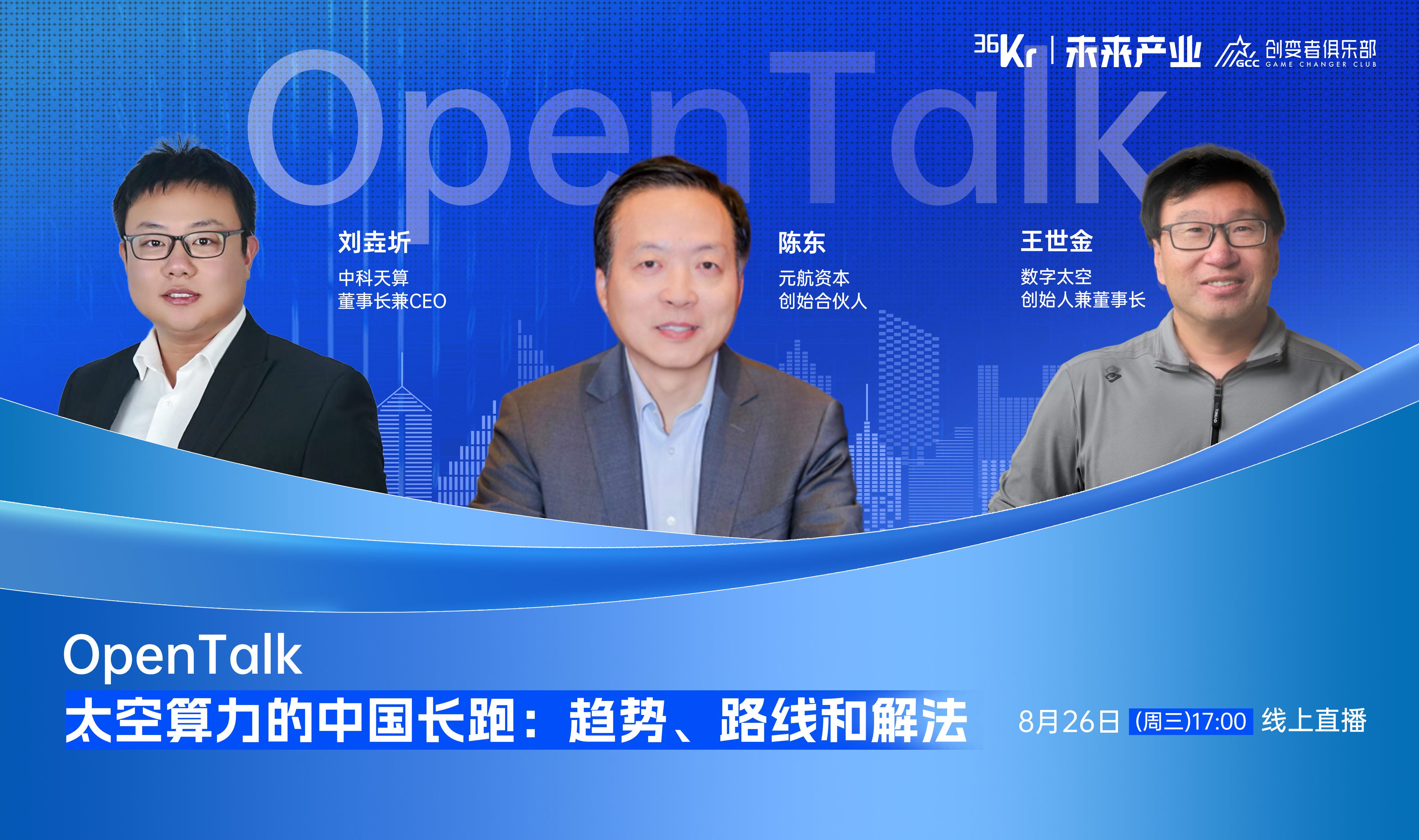
That same afternoon, 36Kr hosted an OpenTalk livestream event themed "China's Long Run in Space Computing: Trends, Routes, and Solutions." The event invited Liu Yaoqi, Chairman and CEO of Zhongke Tiansuan; Wang Shijin, Founder and Chairman of Digital Space; and Chen Dong, Founding Partner of Yuanhang Capital, as guest speakers. They engaged in in-depth sharing on topics including demand scenarios for space computing, technological paths, the differentiated logic of China's route, industrial opportunities, and investment directions, while also interacting with the audience online.
Below is a summary of the key takeaways from this livestream. You are welcome to read, share, and bookmark.
How Far Away is the "4G Era" of Space Computing?
Guest Speaker: Liu Yaoqi, Chairman and CEO of Zhongke Tiansuan, General Commander of the "TianSuan Project," and Deputy Secretary-General of the CCF Fault-Tolerant Computing Special Committee. His research focuses on space-based computing and aerospace computing networks. He has been deeply involved in the design, demonstration, standard formulation, and testing system construction of multiple satellite internet systems in China, and completed the development and deployment of the Aurora series of onboard computers.
He has published over 100 related papers and patents. He was awarded the title of "6G Star Young Scientist" and selected for the New Hundred Star Plan and the "High-Innovation Plan · Youth Talent Lifting Project.
Keywords: Space-based computing infrastructure, space-based large models, space-based information ecosystem, space-native technology
Regarding whether space computing is a real demand or a false proposition, the industry still has no definitive conclusion. From the demand side, ground data centers face multiple constraints in power, land, and heat dissipation; from the capability side, SpaceX has reduced launch costs a hundredfold and is betting on space computing chips and computing constellations. However, opponents argue that the cost of space data centers will be difficult to match with ground levels in the short term, and native technologies have yet to break through.
Liu Yaoqi's judgment on this is: The boundaries of energy, living environments, and information infrastructure are all expanding, and space computing is a natural extension of this logic.
In terms of short-term paths, intelligent remote sensing and intelligent communication are two clear mainlines for implementation.
Intelligent Remote Sensing: Converting processes in remote sensing image processing—such as radiometric calibration, reflectance calculation, and coordinate system conversion—as well as intelligent models like target recognition and change detection into algorithmic tasks. The core resource demand here is parallel computing power, meaning the number of operations executable per unit of time.
Intelligent Communication: A ground base station covers about one square kilometer and serves hundreds of users, while a satellite beam covers thousands of square kilometers. The resulting network planning and optimization issues must also be resolved using computing power.
As the role of satellites shifts from data collectors to real-time service providers, the disruptive opportunities of consumer-grade applications become even more noteworthy. He gave an example: in the future, satellites could use hyperspectral cameras and various sensors to locate fish schools for fishermen, while simultaneously providing smart recommendations on fishing gear usage, net-hauling times, and selling prices. Applications like this might emerge from the satellite internet ecosystem just like Didi and Ele.
me did in the past, redefining the way humans interact with the physical world.
He compared today's satellite internet to the "1G era": stepping into 2G, stable networks and low tariffs will generate massive numbers of users and data; and as remote sensing and communication bandwidth capabilities leap forward in the future, those seemingly non-essential fragmented applications may replicate the explosive growth path of the mobile internet's 4G era, setting off a new wave for satellite internet.
Deduction of the satellite internet development trajectory
At the technical level, Liu Yaoqi believes that the physical boundaries of the space environment are clear. Radiation, temperature differences, vacuum, and microgravity all follow predictable patterns and do not constitute a chaotic system. Therefore, sending computing power into space is an engineering problem that can be gradually overcome.
In essence, it all boils down to "assembling a stable and reliable computer suitable for space that outputs correct results.
In 2024, Zhongke Tiansuan conducted a verification: by remotely uploading data, they deployed a large model onto an orbiting satellite, successfully achieving in-orbit image recognition and Q&A. The significance of this experiment lies in running through the complete chain of "intelligent updates"—just like updating an app on a phone, satellite intelligence can also be updated in orbit.
At the ecosystem level, his advocacy is open-source and open: using an open technology system to lower the threshold for space application development, ultimately pointing toward computing power equity in the AI era. Ground computing output is constrained by infrastructure and geopolitics, whereas space possesses the capability to enable people from different countries, regions, and industries to form localized application ecosystems. This is the value that space computing brings to the world.
The Chinese Route: Compete on Value, Not Computing Power
Guest Speaker: Wang Shijin, Founder, Chairman, and President of Digital Space, Level-2 Researcher, and Director of the Aerospace Digital Intelligence Technology Joint Laboratory. He serves as an expert in multiple industry associations, academic journals, and field expert groups, including the Chinese Institute of Electronics and the China Society of Management Science. He worked at the Space Center of the Chinese Academy of Sciences for 25 years and is a leading figure in China's satellite environment and effect detection.
He was selected as a national candidate for the New Century Talents Project's Hundred, Thousand, and Ten Thousand scheme, and received Outstanding Contribution Awards for Manned Spaceflight and the Lunar Exploration Program. He has won 1 Second Class Prize of the National Science and Technology Progress Award, 5 First Class, 1 Second Class, and 1 Third Class ministerial-level Science and Technology Progress Awards, and holds 50 authorized invention patents.
Keywords: Endogenization of space value, strategic computability, satellite autonomous driving, space brain, computing power migration
The underlying logic of space computing in China and the US is fundamentally different. The American narrative around space computing has specific preconditions: a constrained power grid, privatized land, and the potential cost curve brought by Starship, giving it a strong incentive to move data centers into space. China's constraints are concentrated on computing chips and launch costs, meaning it cannot copy the same roadmap.
1. Intrinsic Space Value: Traditional space value relies on ground realization, operations, and management...